• Innovative Strategies That Create More Profits

How To Start Preparing Your Story


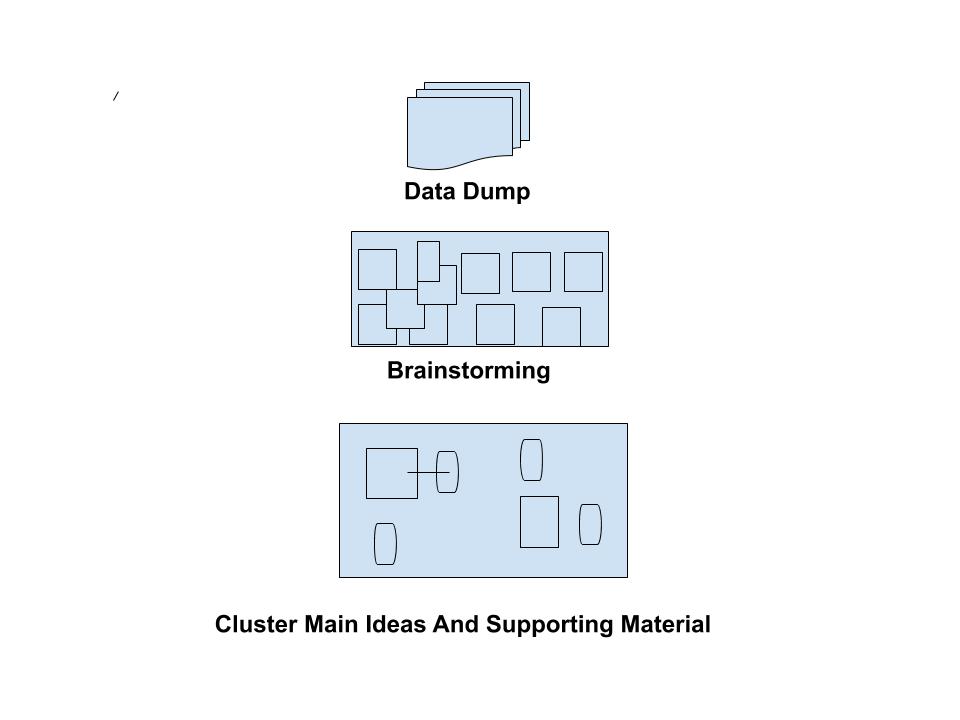
Anyone who has sat through a presentation knows what a data dump is. The presenter goes on an on in minute detail until you want to cry. During the presentation is not the time to use the data dump, but all this data is essential in preparing to tell your story.

Begin with a data dump in a brainstorming session

Jerry Weissman, the author of “Presenting To Win,” has better use for this data. Instead of using it in your presentation, set up a brainstorming session, and do your data dump there.

Preparation for your story begins with the data dump, and the way you arrive at the data dump is through a brainstorming session. Brainstorming is a process of free association, creativity, randomness, openness. It helps you consider all the information you think should be in the presentation without consideration of it being logical or valid. 

Logic comes later when you sort, select, and eliminate data into a form that flows logically to help you get the audience from A to B.

 Here are the good news and the bad news about getting the information we need. The right part of our brain thinks creatively, and the left part of our brain thinks analytically.  Business people are mostly left brain or logical thinkers. So they want to apply logic immediately. But in brainstorming, we want the free flow of creative thinking, so we can get all the information needed to tell our story. We will sort the data out later.

 Another point. The right side of the creative side of our brain controls language. The left side controls our written communication. So the brainstorming session has to be verbal because we are looking for creativity. Creating a presentation is a creative task.

How to manage the brainstorming session

Start with a blank whiteboard and draw frame. The frame is a concept developed by Jerry Weissman. On the outside of the frame, identify the outer limits of the brainstorming session.: 

  • Point B. The objective of the presentation or the Call To Action
  • The audience, Their knowledge level and what they need to know to understand, believe, or act on what you will tell them
  • Benefits. All the audience benefits pertinent to the product or service 
  • External Factors. This term refers to is information that could be positive or negative such as faster-growing market or a new competitor 
  •  Presentation Setting. Who is presenting, when, before or after who, where, audio-visuals available, etc.

Now you are ready for the brainstorming session itself. 

The Brainstorming Session

On the whiteboard, draw the Frame described above. You can use colored markers for different groups of main points and different levels of ideas. The only rule is that every thought is acceptable at the time given.  The idea of the brainstorming session is to identify significant or parent ideas and as many ideas as possible. One person’s “bad idea” may trigger a good idea from someone else. 

Ideas should be free-flowing without structure and be whatever comes to mind. When a significant idea is expressed, write it on the whiteboard and circle it. When supporting ideas are given, also put them on the whiteboard and draw a circle around them. Then connect each one io the major idea. Going through the brainstorming process, you will see a panoramic view of the entire presentation.

When you finally run out of ideas, you can begin to use your brain’s logical side to organize, delete, rearrange, and add data. The next step is to put this data into a structure.

Begin clustering the data into a viable structure

Clustering is how you get from the data dump to a structure for the presentation. Clusters are the major parent ideas. Move the parents and data around if needed. However, it would be best if you reduced these parent ideas down to four or five clusters. Then evaluate and prioritize the data attached to each cluster. These four or five significant clusters and their supporting data form the basis for your presentation. Next, you want to think about the organization and the flow of this information for your presentation.

Success Depends On Knowing Which Market Type You Enter


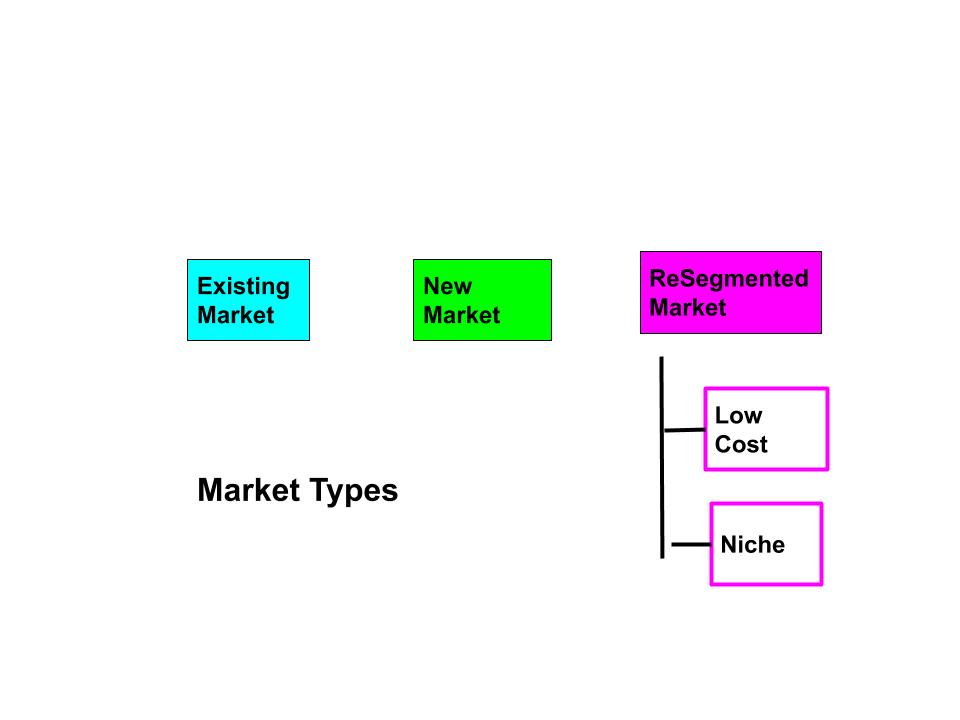
Market Type makes a critical difference when you enter a market, Yet, many entrepreneurs do not consider market type when planning how to enter their market. There are four types of markets and each one needs to be approached differently. Steve Blank in his book, “The Four Steps To The Epiphany” describes the four types as:

  1. Startups that want to enter an existing market
  2. Startups that are creating a new market
  3. Startups that want to resegment an existing market as a low-cost entrant
  4. Startups that want to resegment the market as a niche player

Which market type you plan to enter changes everything. How you evaluate customer needs, customer adoption rates, how customers understand their own needs, and how you position the product to the customer. The market type also changes the market size and how you launch the product into the market.

For example, If you enter an existing market, the market knows you and will accept your new product based on its segmentation and merits. If you enter a new market, no one knows what the product is or who you are so you have to educate the market about what your product can do for them.

Here is some additional information on the four market types.

New Product in an Existing Market

An existing market is easy to understand if you have a better value proposition both buyers are known and competitors are known. So its all about the product and the product’s features and benefits.

New Product in a New Market

This is a situation where you have to create a new, large customer base (large enough to be profitable) that couldn’t be done or wasn’t done before you came along.  What’s your story: a new better product, lower cost, a new class of users, a new product that solves availability problems, or a new skill or technology.

Normally, at first, your product will be ignored. Who needs it? Most people will be skeptical, But at this time you also have no competitors. That’s good because you need time to determine who the users will be and what the specific targeted market will be.

In a new market, your problem isn’t how to compete, its how to convince a customer segment that your product is needed and up to the task.

Creating a new market means you have to determine:

  1. If there is a large enough  customer base for your product
  2. If the customer can be convinced they need and want this new product
  3. What the adoption curve (especially for revenues and margins) looks like
  4. What the financial requirement will be (burn rate during the adoption phase) and if you can raise the funds needed.

New Product in a Resegmented Market. A majority of new startups are aimed at this hybrid market. There are two types of resegmented markets:  Low-cost strategy or a Niche strategy. Segmentation here means you selected a position in the customer’s mind that is unique, understandable and concerns something the customer values.

New Product in a Low-Cost Segmented Market

In this segment, customers will be at the low end of price and value. This is the “disruption” that Clayton Christenson made famous in his book on disruptive technology, These customers will buy a new product if the product is “good enough” and priced at a substantially lower price then what is available now. 

The good news is that established companies will not compete with these new,  low-cost providers because their cost structure makes them unprofitable at these prices. So, they ignore the new entrant. But, over time, the new entrant moves upscale and sooner or later become a significant competitor to the established companies. Then, major competition erupts.

New Niche Product in an Existing Market 

To introduce a new product in this market, you need to ask the question: “would people buy a new product designed specifically to meet a specific niche or mindset (want); even if it costs more or has less performance?

If you enter this market, you have to convince the market that this new product is so different or even radical that it changes the characteristics of the market. Unlike a low-cost entry, here you are only going after segments with higher prices and affluent buyers.   

Resegment Markets Summary

In both resegmented markets, you have to re-frame the product and how people think about the product within their existing market.

Trying to resegment an existing market, especially with a low-cost product can be difficult because you need a long-term plan. Longer-term, moving upmarket will bring intense competition from companies protecting their profits.

Before you jump in, ask yourself, “What kind of a startup are we?”


How To Develop Your Business Model For Better Results


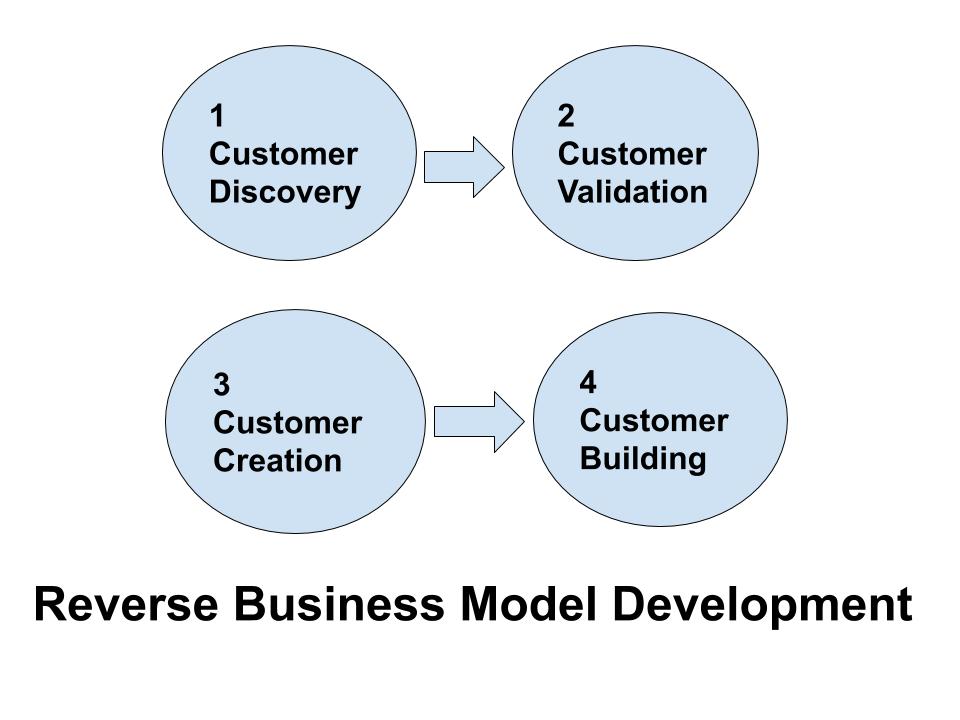
In contrast to the usual product development model, Steve Blank, in his book, The Four Steps To The Epiphany,”

describes his new approach to developing an efficient and effective path

on how to develop your bu for better results and gives your startup a real chance of success. 


Most startups lack a process to create, develop, and validate their business.

They start by developing the product first because they know it’s such a good idea.

They don’t realize that there are millions of needs and wants in the market, and their view of needs may not match the market’s needs or wants.

If you want to succeed, you can’t be founder-centered; you must be customer-centered.


His model has four steps:


One: Customer Discovery. Focuses on finding product-market fit by determining if

the product solves the customer’s needs and wants.

Two: Customer Validation: Develop a sales model that is repeatable.

Three: Customer Creation: Creates and motivates end-user demand,

Four: Company Building: The move from the learning phase to the business execution phase.


This model flips the “development model” on its head. Rather than developing the product

and then finding the market, you do the opposite because it takes several iterations to get it right..

Plus, it’s a frugal way to determine if you have a viable, sellable product.

It also keeps you from hiring sales, marketing, and other company development people too early.


Here is a little more on each strep

Customer Discovery

Based on your hypothesis, you need to go into the market and find out if the problem,

your product and your solution match what the customer wants. 

This combination will take several attempts and several iterations to your hypothesis.

You can’t do this with focus groups; you need the interaction with the customer,

Also, this has to be done by the founder and the founding team.


You can’t send out a salesperson to do this.

You have to read the customer and determine if what the customer

is telling you is correct and if you should modify the product as a result. 


Don’t start the conversation with your product vision. First, find out what the customer needs, 

why he wants it, and what he doesn’t like.

You are there to learn from the customer, not sell him something now.


Customer Validation

In this step, you are trying to build a repeatable sales roadmap for the team that will follow.

This step proves you have found a market and customers willing to buy your product.

It also  validates, through field testing, that your sales process is repeatable,   

This step also confirms your business model, your market, and customers,

identifies your buyers and establishes pricing policies and channel strategy.

Once all of this checks out, you can move to the next step, crossing the chasm into the mainstream market.


Customer Creation

The goal here is to create end-user demand and drive that demand to the sales channel.

But don’t try to scale so quickly that you deplete all your financial resources.

Crossing the chasm is a difficult step and can take some time. 


Also, how you plan to do customer creation will vary with the type of startup and market type you are entering.

For example, a new market with a new product or an established market,

or are you entering an established market with a low-cost product or coming with a new product in a hybrid market.

Each of these has significant revenue and time considerations. See the discussion on market types.


‘Customer Building

Customer building is the step where you transition from a “learning company” into a formal “operating company.”

With appropriate departments, each department becomes mission-oriented within the overall corporate strategy.

 I would love to hear what you think of this approach.

If you used it and how it worked. Email me here. Thanks.


Persuasive Presentations Get Results

Your Presentation Needs To Be Modified For Each Audience


How many presentations have you listened to that were more annoying than informative or persuasive? Most, I’m sure.

Why didn’t your audience jump at the chance to invest in your deal or buy your product?

Was it the opportunity, the product, or the presentation? Many times, it’s the presentation.


Most presentations are designed to put every possible piece of data regarding the “opportunity” on a slide.

These “data dumps” do not impress audiences.

They turn audiences off. If you are talking to investors, they want to know

your product or service and how you will deliver it to a large market.

But they do not care to know about every product feature and function;

they want to see why they should invest in your opportunity.


As Jerry Weissman, in his book, “Presenting To Win,” states:

Your job is to get the audience from A (uninformed) to B (wanting to accept your call to action), and you do it through persuasion.


So the first thing you need to do is recognize that you must customize each presentation to the specific audience you are addressing.

One standard presentation will not do the job. For example, if you have a complicated, technical, or medical product,

will everyone in the audience understand your description, jargon, etc?

You better make sure everyone knows.


How much data do they need? Only enough data to get them from A (uninformed) to

B (further discussions, commitment to investing, a sale), etc.


But facts alone will not persuade them.

They need to know how they will benefit from your opportunity.

What’s in it for them?

Benefits are one area that is missing from most investment presentations.

A simple exit statement is not enough.

One way to accomplish the desired result (B) is to list the important facts you need to convey

and the benefit related to that fact. The fact then benefits, then fact, then benefit.

Rinse and repeat. You don’t need that fact if there is no benefit to the audience for a given fact.


You will know if you got through to the audience if you get a lot of difficult questions.

If you don’t get questions, you probably missed the mark.


How To Get Audience From Point A (skeptic) To Point B (convinced)

Being persuasive is one of the most important skills one can develop. Compelling situations themselves will be varied, each one posing its unique challenges and opportunities.

All presentations have one common element. To take the audience from Point A, the start of your presentation and move them to your objective Point B (your call to action). This dynamic shift is real persuasion.

 According to Weissman, your presentation may be entertaining, most everyone wants that, but entertainment is not the primary purpose. When your point is not clear, you have committed one of the five cardinal sins. When your position is readily apparent, you have the opportunity to achieve your call to action.

Here is a closer look at your challenge. Point A is where your audience starts: uninformed, uninformed, dubious and skeptical about your business. Or in the worst-case, resistant, firmly committed to a position contrary to what you are asking them to do.

Weissman puts it simply. To reach point B, you need to move the uninformed audience to understand, —the dubious audience to believe, —and the resistant audience to act in a neutral way.

Understand, belief, and act are not three separate goals but three stages in reaching a single, cumulative, ultimate goal. Audiences will not act as you want them to if they don’t first understand your story and believe the message it conveys. Point B is the objective of every presentation, and the sure way to create a successful presentation is to begin with, your goal in mind.

You would be surprised at how many people forget to ask for the order at the end of their presentation. At the same time, to reach this goal, you have to understand that you have to see yourself and your presentation from your audience’s point of view. In other words, there must be empathy, an emotional connection, between you and the audience.

One way to do this is to shift your focus from features to benefits. Simply stated, a feature is a fact about your product. A Benefit is how that fact will help your audience. A feature may be necessary, but a benefit is always required. It’s their reason to act.

Every Presentation Is Mission Critical


Every business presentation that requires a decision is critical and depends on your ability to tell your story. You have one objective, persuading your audience to say yes to your call to action.

Most presentations are not stories they are lists of their product’s features and functions. Most presentations are designed to convey data, not to persuade the audience to grab your opportunity. Also, most presentations are packed with technical information, and jargon they may not understand. That means they have to think. Don’t make them think.

When the audience has to think, they are not paying attention to you, and they will soon lose interest and become irritated. Consequently, your message becomes the casualty.

The focus of your presentation must be on the story. It’s your story that makes the presentation powerful and persuasive. A compelling story will also make you more confident. How many times have you sat through a presentation counting the minutes until the pain would be over?  

According to Jerry Weissman, author and Coach, many presentations commit the following five cardinal sins,

1. No clear point. The audience wonders why they are there. This sin is called the data dump.

2. No audience benefits. The presenter talks about things the audience may not care about.

3. No clear flow. The presenter jumps from topic to topic, and the audience has to try to keep up.

4. Too detailed. Too many facts not relevant and too technical

5. Too long. The audience gives up before the presenter does.

When you commit these sins, you waste everyone’s time, and you miss your opportunity to persuade your audience.

Entrepreneurs are often absorbed in the many issues that have to deal with; they think every tree is necessary when the audience only wants to know about the forest. “They think that for the audience to understand anything, they have to be told everything.” The solution to these problems is to focus on your goal: persuading the audience to go from skeptic to evangelist.

How to find your perfect market niche

Harry Browne was one of America’s most successful salesmen, and he only worked 15-20 hours per week. He believed sales were natural. He passed away some years ago, but he passed along the following information he called the secret to sales success. I wanted to start this
module with his analysis because it is so fundamental to sales success. We will have other articles later on additional information.

Before you spend money on marketing and advertising, you have to find your market niche, and that niche is in the mind of your customers. Following is a condensed view of Harry’s sales secret.

The customer is the object of the sales process because the only reason we produce anything is to have things to consume — to use and enjoy because of the happiness it provides. So the one who consumes an item is the one who judges its worth.

It’s the customer’s values that count. His preferences, through the prices he is willing to pay, and your success depends on the value others place on your products and services. Also, since the customer has limited resources, he is not willing to do something unprofitable to himself.

No one willingly does something unless he’s decided it is his most profitable alternative because no one has unlimited resources. There is a shortage of funds, and everyone’s desires always outnumber resources, so everyone is choosing.

So half of the success story is: you will succeed if you are providing people what they want.

However, many people produce what they think people would like and be willing to pay for, but they are wrong. People seek happiness, and happiness is relative. Each person has a different concept of what will bring them joy. Their mistake is making the judgment based on their values to determine what other people will want. It’s not what you want that determines what other people will buy — it’s what they want that matters.

You have to make it your business to find out what people want – not what you want, and give it to them. Also, find out before you make your offer. We will find out how to do this in a sales call in another article. The net of this is that your niche must include the buyer’s values and the price the buyer is willing to pay as part of your niche — not just demographics.


Inbound Marketing – Its Importance and Benefits

Today, inbound marketing is viral. The terms “content marketing” and “inbound marketing” refer to the same thing and are often used interchangeably. It is a marketing strategy that uses almost no specific form of advertisement at all. Instead, this method focuses heavily on providing information or content on Internet-based media such as blogs, social media, online forums, and podcasts.

Contents can be in the forms of articles, infographics, videos on websites, or even a short, simple post on social media accounts. There are two crucial factors to consider for inbound marketing to be effective: quality and subtlety. The contents provided must be relevant and interesting
enough to keep the audience engaged. However, there cannot be an apparent sales pitches because they tend to drive the audience away. Inbound marketing is challenging but can also be very useful in the long run as it aims to build a good reputation in the market. The downside is that it takes severe investments of time and effort to produce quality content, and it takes considerable time to begin working.

Why Inbound Marketing is Important

While TV ads are still valid forms of outbound marketing, it is more difficult for companies to hone in on target customers. Email newsletters do a better job for that purpose, but there is always a chance that it ends up in the spam box and gets dismissed without being opened at all.
Internet ads can be quite annoying, too, and people try to avoid them by preventing the ads from appearing in the first place. Direct messaging in social media is probably a friendlier format of a newsletter, but you can always use additional tools to reach out to more people.

By providing relevant information based on people’s search queries, your products are integrated into the contents. The advertisement is indirect, mainly; it is so subtle that the audience doesn’t feel directed to any particular product. Of course, the point of marketing is to generate sales; it seems counterproductive at first, but the absence of sales pitches surprisingly works well.

In today’s competitive market, startups need to find effective methods to deliver their message. Providing quality relevant information in a blog or social media will keep readers and followers engaged in the long run. The unobtrusive nature of inbound marketing helps your company earn a place as an authoritative name in the niche or industry at large.

Major Benefits
Inbound marketing generates leads instead of direct sales. All the content used to launch the marketing effort help establishing a relationship with the audience. This relationship eventually drives traffic to the company’s website and can result in considerable online exposure. The more content you produce, the more significant the exposure you get. The additional benefit is word-of-mouth marketing. If people like your content, chances are they share those contents with friends, families, and colleagues on social media and messaging apps. This relationship is how you solidify your reputation as a trusted brand/company and increase visibility in the market.


Outbound Marketing – Its Importance and Benefits

Advertisements come in all sorts of formats and delivered to the audience through many different methods. You see them on TV, billboards, newspapers, magazines, flyers, e-mail campaigns, banners, and website pages, or perhaps you hear similar things on radio and
podcasts. And then there are direct calls from salespeople. These advertisement formats are parts of sales strategy, commonly referred to as outbound marketing. Outbound marketing is meant to be interruptive as the audience is involuntarily exposed to the advertisements. These advertisements are directed at particular audiences as opposed to large, more general audiences.

Why It Is Important for Business
The main objective of outbound marketing is to acquire as many sales leads as possible. For startups looking to get on the map, there are very few (if any) marketing strategies that can reach more targeted people in a shorter amount of time. Small businesses generally don’t have the budget to buy advertisements on primetime shows, but they can reach their target audience via email or direct messaging. It is an affordable yet effective outbound marketing strategy anyone can use.

Outbound marketing, despite its antiquated status in the modern business landscape, remains essential for both new and established companies. For new companies, outbound marketing is vital to spread the word of their existence and what they have to offer. It helps companies develop “first contact” with potential customers. The more-established businesses also utilize the same method to introduce changes or new products to customers.

In the old days, outbound marketing mostly happened on print media, including newspapers and magazines. Now that people rarely, if ever, buy newspapers anymore, emails have become the prominent medium of choice besides TV. However, the former is much more affordable, and the result is almost certainly more measurable.

Advantages of Outbound Marketing

Familiarity is a valuable benefit of outbound marketing. People of all generations have grown accustomed to product advertisement broadcast at regular intervals on TV and radio. The audience knows that there are going to be advertisements in the middle of a broadcast. To some extent, people understand the companies behind the products provide the money to fund the show itself. In a world of social media, direct messaging and email newsletters are even more useful. Social media acts like channels to bring targeted customers to one place. People follow your account because they are interested in what you have to offer. Moreover, direct message and email always carry a personal touch, which is an indispensable element in any marketing effort.

Important Ways To Improve Your Direct Mail Marketing

For some, direct response marketing seems old fashioned. It is not. It’s just getting more effective. More than 80% of marketers credit email as their most vital channel for customer acquisition so email marketing is not going away anytime soon. New trends are emerging that will help you increase leads and conversions and improve your relationship with your prospects and customers. For example, Personalization is becoming more and more important and you need to learn how to target potential customers and target your messages to them.

We need to gather more information about our target audience from the analytics we get from previous mailings. Also, segmenting prospects by demographics, expertise, decision-making level makes your message more personal. Are the recipients active or inactive, opening or not clicking through at all, etc. Some people are going back to plain text emails because they appear to be more personalized.
Ask for more information from responders and you will get more information allowing you to get more personal on the next mailing.

Mobile messaging is becoming more important. Mobile messages have a higher open rate and responses are much faster and easier. You can also use more casual language and people search differently when looking for information. Often in sentences rather than keywords. Lots of people are moving away from typing.

To be more effective, try to integrate your email marketing with other marketing efforts so prospects are getting a consistent message from the phone, email, website, and social media. Build a relationship with your target prospects. Show them content that tells them you are an expert and understand the challenges they are facing.

And finally, test and test again including subject lines, time of mailing, different calls to action, using emojis in subject lines (some people get much higher open rates with emojis), embedded video and graphics. You have your lists and you are continuing to add to these lists, so now is the time to experiment especially when the cost to do direct response marketing is so inexpensive. It’s a great way to build a pipeline of prospects.