Your sales pipeline is in good condition.
They welcome you, ask for more details, and request proposals. Your sales team then follows up, answers their questions, and demonstrates how the product works.
However, the deals are not being concluded.
Decisions are postponed. Projects are taken until the following quarter. Procurement requests higher discounts. Some potential customers cease sending replies.
A common response is to put more pressure on the sales team, with leaders requesting more calls, better follow-up, stronger closing skills, or more leads.
However, the real issue may not be sales activity.
Your sales deals could be stalling because buyers can’t tell what makes you different from your competitors.
If competing offers look the same, customers have no reason to act quickly. Instead, the buyer will rely on price to decide between the suppliers or just do nothing at all.
A real issue here could be a competitive advantage that looks like a sales problem.
Buyers Do Not See Your Company the Way You Do
Most companies believe they are different.
They emphasize quality, experience, service level, responsiveness, technical abilities, or dedication to customers. However, even when genuine, competitors often say similar things.
Look at the websites of several companies in the same industry, and you are likely to see familiar promises:
- High-quality products
- Customized solutions
- Experienced employees
- Exceptional service
- Competitive pricing
- On-time delivery
While these qualities may help a company be considered as a supplier, they seldom give buyers a good reason to choose one over another.
To buyers, all offers begin to look identical: if each company promises quality, service, and expertise, those features stop being distinctive and become what’s expected.
Even if your company believes that its people, processes, or products are superior, this won’t affect customers’ decisions unless they can see or measure it.
Similarity Makes Waiting the Safest Choice
Switching to a different supplier or taking on a new solution involves risk.
The person making the purchase might need to arrange funding, involve others in the decision, retrain staff, change a process, coordinate the installation, or take responsibility if the decision proves wrong.
If your solution improves only slightly over the others, that small gain might not justify the risk and effort of switching.
The prospect can wait.
The customer could remain with their present supplier, put off the project, request more information, or collect additional proposals. While your salesperson might see the continued discussions as interest, the buyer still doesn’t feel enough urgency to proceed.
Which is why ‘no decision’ usually beats out any other option.
The idea is not dismissing your solution; it’s merely that they don’t consider there to be a strong enough justification for proceeding.
When Buyers See No Difference, Price Takes Over
When customers can’t spot a significant difference between suppliers, they have to rely on another way to decide.
In most cases, price becomes the deciding factor.
Procurement asks for discounts. When negotiating, prospects refer to a competitor’s proposal in order to secure concessions. Salespeople ask for special pricing because they think the only way to save the deal is to lower the price.
Although the company could secure some deals, they would do so at reduced margins.
This sets off a dangerous cycle. To compensate for the lost margin, the business needs higher sales. Marketing is asked to secure more leads and sales focus on pursuing more opportunities. The pipeline ends up growing, but conversions remain low since the real issue – a lack of differentiation – has not been addressed.
In the end, the company finds itself involved in the kind of competition it had hoped to avoid.
While it works harder to secure business, it gives customers fewer reasons to choose it.
Improved messaging will not solve the problem of an interchangeable offer.
When a company finds its deals have stalled, it usually revises its website, sales presentation, or value proposition.
Better communication can help customers recognize the advantage you already have; however, new words can’t create an advantage if your company doesn’t have one.
Positioning is how you communicate the value you offer.
The meaningful value is what makes your offer stand out.
Competitive advantage is the difference that you can provide on a profitable and consistent basis and better than other available options.
A new slogan won’t solve the problem if your offer is similar to others’. The company needs to create a difference that matters to buyers.
That difference could include:
- Shorter and more dependable lead times
- Guaranteed product availability
- Reduced downtime
- Faster installation
- Lower energy or maintenance costs
- Easier regulatory compliance
- Better performance data
- Reduced implementation risk
- A service that eliminates work for the customer
- Accountability for an outcome rather than delivery of a product
A significant difference needn’t be large; it only has to improve something the customer genuinely cares about.
Diagnose Why Your Deals Are Stalling
Before you start a new marketing campaign or lower your prices, carefully examine your existing pipeline.
Examine a representative group of opportunities:
- Deals that closed successfully
- Deals lost to competitors
- Deals lost to “no decision
- Deals that have remained open much longer than expected
Then ask:
- What problem originally caused the customer to consider changing?
- How urgent and costly was that problem?
- What in our offer did the buyer think was different?
- Does that difference matter to the person who actually made the final decision?
- What made the buyer think that it was all right to wait?
- When did the talk turn to price?
- What characteristic of the customers who won was lacking in the customers who didn’t?
- Can the customer clearly state the reason why selecting us would lead to a better result?
This will help you determine whether the real problem lies in qualification, urgency, communication, customer value, or the offer itself.
The answers give you the insight needed to develop a stronger concept.
Turn the Insight Into a Compelling Concept
Imagine an industrial supplier that describes itself as a supplier of high-quality replacement components.
Customer interviews show that buyers are not mainly concerned with component quality; rather, they worry about unexpected production stoppages and the uncertainty around replacement-part availability.
A stronger concept might be:
We help manufacturers keep vital production lines running by ensuring they have access to the replacement parts most likely to cause expensive downtime.
That idea offers several options: the company could set up a critical-parts inventory program, offer a predictive monitoring service, enter into a priority manufacturing agreement, provide a delivery guarantee, or choose an uptime-based service package.
The difference goes beyond general quality assurance; it offers a specific solution to a problem your customer finds costly.
The company has moved beyond simply stating what it sells to explaining why customers should choose it.
Validate the Difference Before Scaling It
Test your best ideas before making large investments.
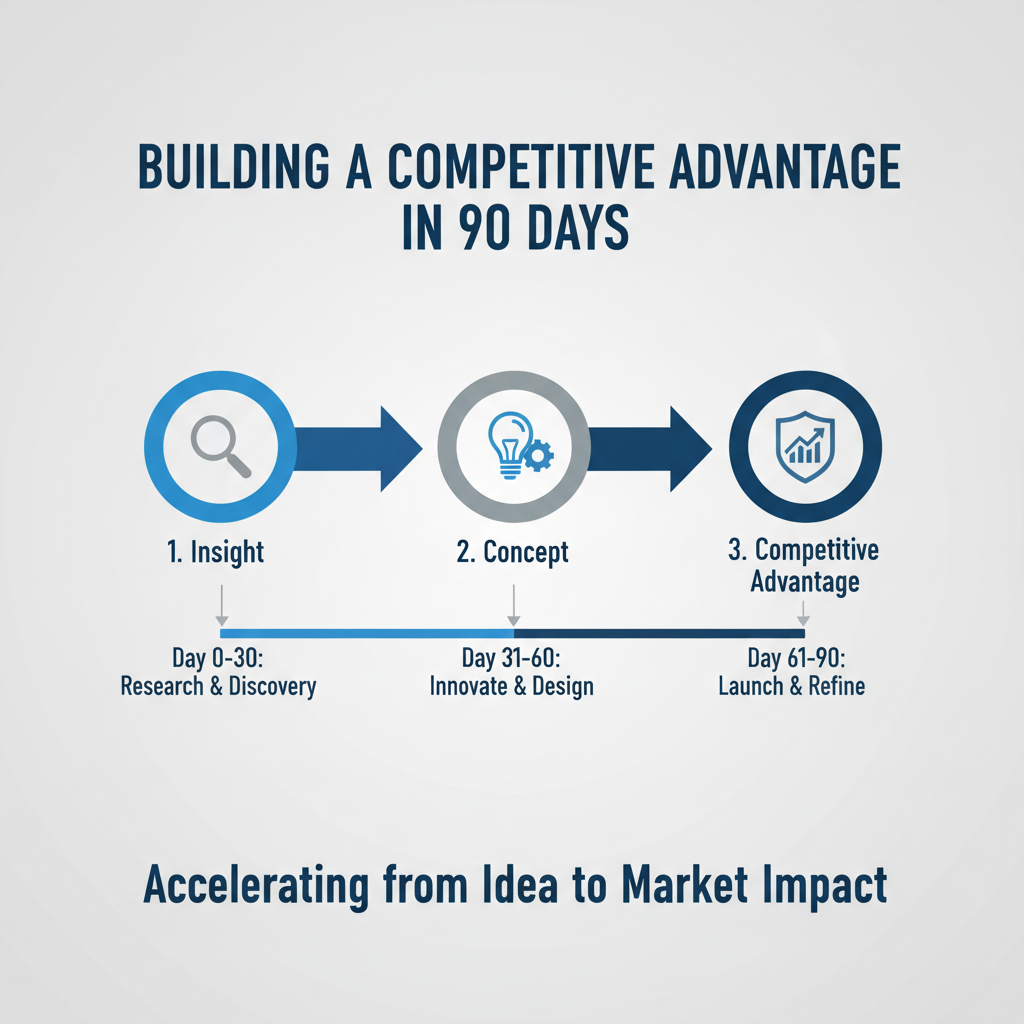
A focused 90-day process can provide evidence:
Days 1–30: Insight
We won some reviews, lost others, had some that stalled, and some in which no decision was reached. We should interview customers, prospects, and salespeople. Identify the problems with the utmost urgency, considering their economic impact and the level of dissatisfaction.
Days 31–60: Concept
Develop several methods for addressing those problems. For each idea, assess customer value, uniqueness, feasibility, profitability, and defensibility.
Days 61–90: Competitive Advantage
Test the strongest idea with a clearly defined group of prospects or customers. Find out about buyer interest, access to the people who make the decisions, the willingness to take part in a test, price resistance, the progress of the sales cycle, and the rate of conversion.
The aim is not to show that your initial idea was correct; rather, it is to discover which differences customers genuinely value before you spend major resources.
Give Buyers a Reason to Choose—and Act
It’s simple to place the blame on careful buyers, inadequate salespeople, tough competitors, or on the poor state of the economy when deals come to a halt.
But CEOs should ask a more important question:
Can our customers clearly explain that choosing us will lead to a substantially better outcome?
If they can’t, increasing the number of leads won’t solve the problem; additional follow-up won’t create urgency, and although discounts may secure a few deals, they will damage your margins and pricing power.
Customers move forward when three conditions are present:
- The issue is worth solving.
- Waiting may be more costly or risky than taking action.
- One solution offers a meaningfully better result.
Without those conditions, the deal stalls.
With these in place, your company stops being just another supplier. You become the top choice for a problem your customer can’t afford to ignore.Your sales pipeline is in good condition.
They welcome you, ask for more details, and request proposals. Your sales team then follows up, answers their questions, and demonstrates how the product works.
However, the deals are not being concluded.
Decisions are postponed. Projects are taken until the following quarter. Procurement requests higher discounts. Some potential customers cease sending replies.
A common response is to put more pressure on the sales team, with leaders requesting more calls, better follow-up, stronger closing skills, or more leads.
However, the real issue may not be sales activity.
Your sales deals could be stalling because buyers can’t tell what makes you different from your competitors.
If competing offers look the same, customers have no reason to act quickly. Instead, the buyer will rely on price to decide between the suppliers or just do nothing at all.
A real issue here can look like a competitive advantage but show up as a sales problem.
Buyers Do Not See Your Company the Way You Do
Most companies believe they are different.
They emphasize quality, experience, service level, responsiveness, technical abilities, or dedication to customers. However, even when genuine, competitors often say similar things.
Look at the websites of several companies in the same industry, and you are likely to see familiar promises:
- High-quality products
- Customized solutions
- Experienced employees
- Exceptional service
- Competitive pricing
- On-time delivery
While these qualities may help a company be considered as a supplier, they seldom give buyers a good reason to choose one over another.
To buyers, all offers begin to look identical: if each company promises quality, service, and expertise, those features stop being distinctive and become what’s expected.
Even if your company believes that its people, processes, or products are superior, this won’t affect customers’ decisions unless they can see or measure it.
Similarity Makes Waiting the Safest Choice
Switching to a different supplier or taking on a new solution involves risk.
The person making the purchase might need to arrange funding, involve others in the decision, retrain staff, change a process, coordinate the installation, or take responsibility if the decision proves wrong.
If your solution improves only slightly over the others, that small gain might not justify the risk and effort of switching.
The prospect can wait.
The customer could remain with their present supplier, put off the project, request more information, or collect additional proposals. While your salesperson might see the continued discussions as interest, the buyer still doesn’t feel enough urgency to proceed.
Which is why ‘no decision’ usually beats out any other option.
The idea is not dismissing your solution; it’s merely that they don’t consider there to be a strong enough justification for proceeding.
When Buyers See No Difference, Price Takes Over
When customers can’t spot a significant difference between suppliers, they have to rely on another way to decide.
In most cases, price becomes the deciding factor.
Procurement asks for discounts. When negotiating, prospects refer to a competitor’s proposal in order to secure concessions. Salespeople ask for special pricing because they think the only way to save the deal is to lower the price.
Although the company could secure some deals, they would do so at reduced margins.
This sets off a dangerous cycle. To compensate for the lost margin, the business needs higher sales. Marketing is asked to secure more leads and sales focus on pursuing more opportunities. The pipeline ends up growing, but conversions remain low since the real issue – a lack of differentiation – has not been addressed.
In the end, the company finds itself involved in the kind of competition it had hoped to avoid.
While it works harder to secure business, it gives customers fewer reasons to choose it.
Improved messaging will not solve the problem of an interchangeable offer.
When a company finds its deals have stalled, it usually revises its website, sales presentation, or value proposition.
Better communication can help customers recognize the advantage you already have; however, new words can’t create an advantage if your company doesn’t have one.
Positioning is how you communicate the value you offer.
The meaningful value is what makes your offer stand out.
Competitive advantage is the difference you can provide profitably and consistently, better than other available options.
A new slogan won’t solve the problem if your offer is similar to others’. The company needs to create a difference that matters to buyers.
That difference could include:
- Shorter and more dependable lead times
- Guaranteed product availability
- Reduced downtime
- Faster installation
- Lower energy or maintenance costs
- Easier regulatory compliance
- Better performance data
- Reduced implementation risk
- A service that eliminates work for the customer
- Accountability for an outcome rather than delivery of a product
A significant difference needn’t be large; it only has to improve something the customer genuinely cares about.
Diagnose Why Your Deals Are Stalling
Before you start a new marketing campaign or lower your prices, carefully examine your existing pipeline.
Examine a representative group of opportunities:
- Deals that closed successfully
- Deals lost to competitors.
- Deals lost to “no decision”
- Deals that have remained open much longer than expected
Then ask:
- What problem originally caused the customer to consider changing?
- How urgent and costly was that problem?
- What in our offer did the buyer think was different?
- Does that difference matter to the person who actually made the final decision?
- What made the buyer think that it was all right to wait?
- When did the talk turn to price?
- What characteristic of the customers who won was lacking in the customers who didn’t?
- Can the customer clearly state the reason why selecting us would lead to a better result?
This will help you determine whether the real problem lies in qualification, urgency, communication, customer value, or the offer itself.
The answers give you the insight needed to develop a stronger concept.
Turn the Insight Into a Compelling Concept
Imagine an industrial supplier that describes itself as a supplier of high-quality replacement components.
Customer interviews show that buyers are not mainly concerned with component quality; rather, they worry about unexpected production stoppages and the uncertainty around replacement-part availability.
A stronger concept might be:
We help manufacturers keep vital production lines running by ensuring they have access to the replacement parts most likely to cause expensive downtime.
That idea offers several options: the company could set up a critical-parts inventory program, offer a predictive monitoring service, enter into a priority manufacturing agreement, provide a delivery guarantee, or choose an uptime-based service package.
The difference goes beyond general quality assurance; it offers a specific solution to a costly customer problem.
The company has moved beyond simply stating what it sells to explaining why customers should choose it.
Validate the Difference Before Scaling It
Test your best ideas before making large investments.
A focused 90-day process can provide evidence:
Days 1–30: Insight
We won some reviews, lost others, had some that stalled, and some in which no decision was reached. We should interview customers, prospects, and salespeople. Identify the problems with the utmost urgency, considering their economic impact and the level of dissatisfaction.
Days 31–60: Concept
Develop several methods for addressing those problems. For each idea, assess customer value, uniqueness, feasibility, profitability, and defensibility.
Days 61–90: Competitive Advantage
Test the strongest idea with a clearly defined group of prospects or customers. Find out about buyer interest, access to the people who make the decisions, the willingness to take part in a test, price resistance, the progress of the sales cycle, and the rate of conversion.
The aim is not to show that your initial idea was correct; rather, it is to discover which differences customers genuinely value before you spend major resources.
Give Buyers a Reason to Choose—and Act
It’s easy to blame careful buyers, inadequate salespeople, tough competitors, or the economy when deals stall.
But CEOs should ask a more important question:
Can our customers clearly explain that choosing us will lead to a substantially better outcome?
If they can’t, more leads won’t solve the problem; more follow-up won’t create urgency; and although discounts may secure a few deals, they will damage your margins and pricing power.
Customers move forward when three conditions are present:
- The issue is worth solving.
- Waiting may cost more or carry more risk than taking action.
- One solution offers a meaningfully better result.
Without those conditions, the deal stalls.
With these in place, your company stops being just another supplier. You become the top choice for a problem your customer can’t afford to ignore.