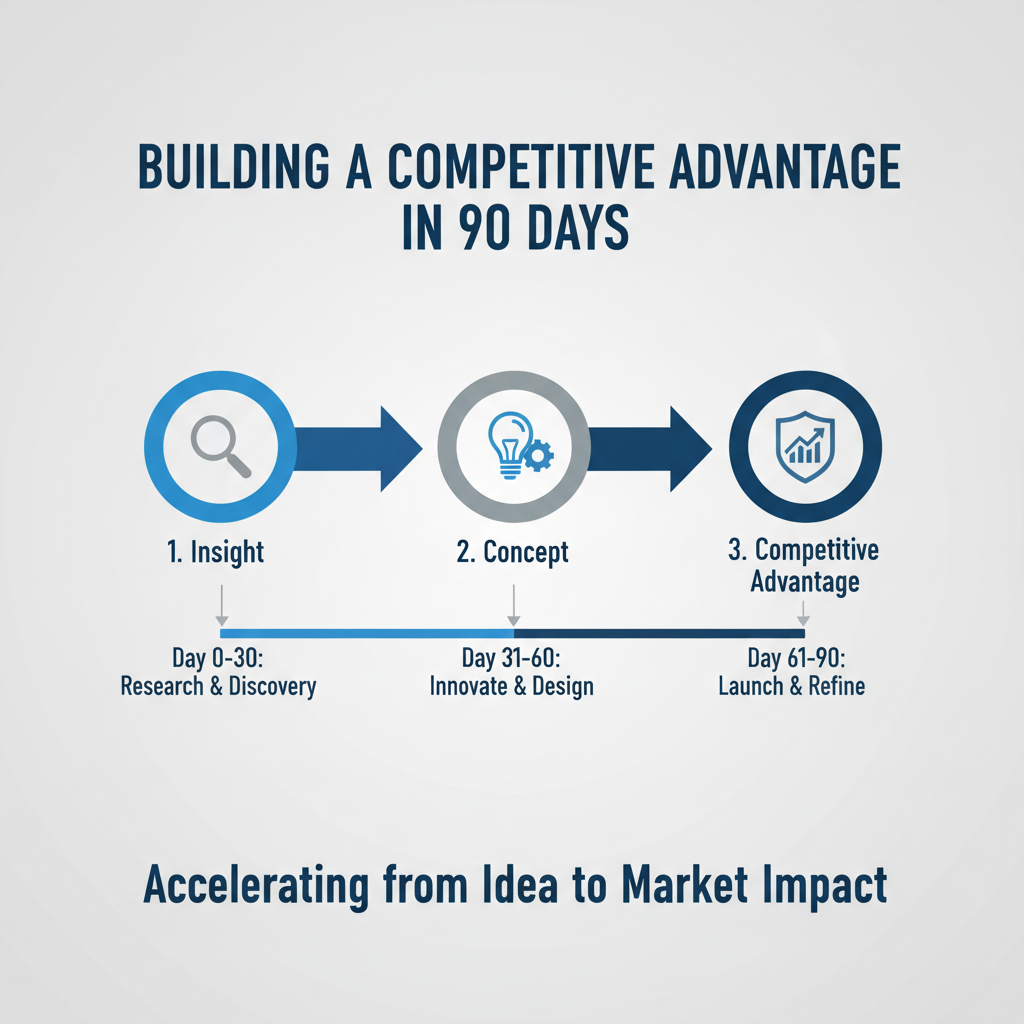
• Innovative Strategies That Create More Profits

 Why Companies Don’t Create a Competitive Advantage


2-minute read

1. Lack of Deep Understanding (Research)

Most firms don’t invest enough time in diagnosis. They skip or rush the research phase that reveals what customers truly value or where hidden opportunities exist.

  • They rely on surface data — “what competitors are doing” — instead of insight research into unmet needs, friction points, or emotional drivers.
  • Without these insights, they can’t identify leverage points for differentiation or innovation.

Result: They fight on the exact dimensions (price, speed, features) as everyone else.

2. Absence of Creativity

Most companies don’t have an in-house creative team or processes. They rely on brainstorming or random innovation rather than structured creativity techniques (like vertical or lateral creative thinking.  

  • Creativity is often seen as “soft” or “unpredictable,” not a disciplined business tool.
  • Management prefers analytical thinking — forecasting, cost-cutting, optimization — over imaginative exploration.

 Result: Few new ideas emerge that could form the basis of a lasting competitive advantage.

3. Strategic Myopia

Leaders inherently focus on short-term competition rather than long-term positioning.

  • Quarterly pressures from investors and boards push executives to focus on “beating” the competitor next quarter, not “changing the game” next year.
  • They confuse “marketing differentiation” (ad claims, features, packaging) with strategic differentiation (unique value creation that customers can’t easily copy).

Result: Endless competitive battles, low margins, little defensibility.

4. Fear and Risk Aversion

Creating a competitive advantage requires bold choices and focus.

  • It often means saying no to certain markets, products, or customers — something many leaders fear.
  • They worry about being wrong, wasting resources, or looking foolish if innovation fails.
  • Relying on ” safer” choices (cutting prices, copying competitors, adding small features) feels less risky but erodes long-term profitability.

 Result: Fear breeds sameness.

5. Overreliance on Price

When companies can’t articulate or deliver unique value, they default to price competition.

  • It’s measurable, immediate, and easy to explain to sales teams.
  • But price wars destroy margins, reduce innovation budgets, and weaken brand equity.

 Result: They trap themselves in a low-profit cycle, making it harder to invest in creativity or strategy.

6. Lack of Integration Between Creativity and Strategy

Even when firms generate creative ideas, they fail to link them to strategic advantage.

  • Ideas aren’t validated through research, aligned with customer needs, or positioned within the company’s core strengths.
  • Strategy departments rarely collaborate with creative or R&D teams.

Result: Creative sparks seldom become strategic firepower.

7. Leadership Mindset and Culture

Competitive advantage begins with leadership philosophy.

  • Some leaders are operators, not creators — they’re great at efficiency, not at invention.
  • Cultures that punish failure, undervalue experimentation, or reward only “safe wins” which suffocate creative advantage.

Result: They optimize instead of innovate,

Summary

Most companies don’t lack ability — they lack alignment. A true competitive advantage requires integrating research, creativity, and strategy within a culture that rewards insight, experimentation, and courage.

Companies don’t create a competitive advantage because it’s harder — but it’s the way to stop fighting and start leading.

More information is available on my Blog.

Jim Zitek

 I turn complex product problems into creative solutions 

with a competitive advantage.

Turn Problems Into Opportunities With Research and Diagnosis


In business, problems are not just obstacles. They can be opportunities to grow and gain an advantage over competitors, but only if you understand and solve their root causes. Many companies fix only surface issues, which leads to more trouble later. That’s why it’s important to use both research and diagnosis.

Research and diagnosis each play a different role, but both are important for solving problems in a company. Research helps you understand the basics and explore options. Diagnosis looks closely at the specific issue. Together, they create a solid way to find, understand, and fix tough challenges.

Phase 1: Leveraging Research for General Knowledge and Context

Business research is a systematic investigation into a particular area. It aims to discover facts, develop new understanding, or create products or services. The main goal is to generate information that informs strategies, products, and operations.

How companies use Research to solve problems:

  • Market Research for Product-Market Fit:
      • Problem: A new product isn’t selling as expected.
      • Research Approach: Conduct extensive market research. This could involve surveys, focus groups, competitive analysis, and trend forecasting.
      • Outcome: Discovering that the target audience finds the pricing too high, the features confusing, or that a competitor offers a similar solution with better benefits. This knowledge suggests potential avenues for diagnosing and solving problems.
  • User Experience (UX) Research for Product Adoption:
      • Problem: Users are abandoning a key feature in an application.
      • UX research encompasses usability testing, user interviews, and the analysis of user behavior data, including heatmaps and session recordings.
      • Outcome: Gaining general insights into user mental models, pain points, and preferences across the user base. This helps establish norms and identify potential areas of friction that may contribute to the abandonment of the specific feature.
  • Competitive Analysis for Strategic Positioning:
      • Problem: Losing market share to a competitor.
      • Research Approach: Conduct a comprehensive analysis of competitor strategies, product offerings, pricing, marketing tactics, and customer reviews.
      • This research provides industry benchmarks and best practices, helping you see where competitors are strong or weak. This context is key to understanding why your business might be underperforming.
  • Technological Research for Innovation:
    • Problem: Outdated technology hinders efficiency and product capabilities.
    • Research Approach: Investigate emerging technologies, assess their capabilities, costs, and integration challenges.
    • The research helps you fully understand new technology’s limits and costs. This information sets the stage for diagnosing technical problems and finding solutions.

Phase 2: Employing Diagnosis to Pinpoint the Specific Problem

Diagnosis uses what you’ve learned from research to focus on a specific problem in the company. The goal is to discover precisely what’s wrong and why, so you can take the right action.

How companies use Diagnosis to solve problems:

  • Product Problem: Feature Non-Adoption  
      • Research Context: UX research has shown that users value ease of use and clear instructions.
      • For diagnosis, run A/B tests on the feature’s onboarding flow. Analyze detailed analytics data for just that feature—interview users who abandoned it. Use the ‘5 Whys,’ focusing strictly on the feature’s non-adoption.
      • Outcome: Despite the feature’s usefulness, diagnose a confusing button label and a missing visual cue as specific problems.
  • Business Problem: Declining Sales in a Specific Region  
      • Research Context: Market research has revealed a general shift in the market towards online purchasing and personalized services.
      • Analyze region-specific sales data. Focus on product lines, sales channels, customer groups, and competitive activities. Interview the region’s sales teams and customers.
      • Outcome: Pinpoint a strong local competitor’s superior online experience as the cause behind the regional sales decline.
  • Operational Problem: Recurring Production Delays  
    • Research Context: Industry research on lean manufacturing identified best practices for supply chain management.
    • Map the production process step by step with a flowchart. Conduct time-motion studies at each stage. Analyze past data on delay points. Use Fault Tree Analysis to find recurring bottlenecks.
    • Outcome: Identify a frequently failing machine, due to poor maintenance, as the cause of production line delays.

The Synergy: Research Guides, Diagnosis Confirms

The real strength lies in combining both approaches.

  • Research gives context and helps you form ideas about what might happen. It shows you the big picture and points you in the right direction. This knowledge is the foundation for diagnosis and solutions.
  • Diagnosis checks these ideas and finds the real cause. It turns broad research into a clear understanding of the problem.

Without research, diagnosis can be too narrow and may miss new trends or creative solutions. Without diagnosis, research stays theoretical and may not lead to real answers for urgent problems.

Conclusion

By using both research and diagnosis, companies can shift from just reacting to problems to growing in a planned way. This approach leads to solutions that last and give a real advantage, not just temporary fixes.

Thanks for your time. I know it’s valuable.

Jim Zitek

I Turn Complex Product Problems into Successful Solutions 

With a Competitive Advantage


Are You Treating The Symptom or The Disease

2-minute read

Problems can lead to growth and innovation in business if they are understood and addressed effectively.

Many companies address only the surface issues, so the same problems keep coming back. Using research and diagnosis can help stop this pattern.

Research and diagnosis make problem-solving more effective. Research helps you see the bigger picture, while diagnosis finds the exact issue in your business. Knowing when to use each approach is essential for success.

By combining research and diagnosis, you can better identify, understand, and solve complex business and product challenges.

Phase 1: Research – Gaining General Knowledge and Context

Business research explores a topic, gathers facts, learns more, or develops new products and services. The primary goal is to gather knowledge that enables you to make informed decisions, enhance products, and run operations more efficiently.

Phase 2: Diagnosis – Finding the Specific Problem

Diagnosis means using what you learned from research to solve a specific problem in your company or product. The aim is to identify precisely what is wrong and why, so you can rectify it directly.

How Research and Diagnosis Work Together

Research gives you the background and ideas to explore. It helps you see the big picture and prepares you for diagnosis.

Diagnosis checks your ideas and finds the real cause of the problem. It takes what you learned from research and clarifies the issue.

Conclusion

Companies use research and diagnosis to move beyond quick fixes and achieve real, lasting growth.

Thanks for your time. I know it’s valuable.

Jim Zitek

I Turn Complex Product Problems into Successful Solutions 

With a Competitive Advantage

How To Generate, Test, and Protect Product Ideas That Deliver On Your Concept.

Every sale begins with a story, and every strong story starts with a clear concept. Your concept is the heart of your message. Once you know it and use it to create strong sales ideas, you move beyond selling features and start offering real value.  

To do this effectively, let’s break the process into clear, actionable steps so you can turn a core idea into compelling messages that customers can’t resist.


Framing Your Concept (1–2 Sentences)

Let’s start with this: a concept should always be one or two sentences. The reason? Clarity wins every time.

For example:

‘A subscription service that delivers healthy meals in 30 minutes.’

‘A platform that guarantees 99% uptime by fixing problems before customers see them.’

Keep it short and precise. This helps your team stay on the same page and makes a strong impression on your customers.


Defining Creative Techniques

Once you have your concept, the next step is to generate sales ideas from it. This is where creative techniques help, including both vertical and lateral approaches.


Vertical thinking uses logical, step-by-step methods to turn your concept into practical sales ideas.

  • SWOT Analysis: This involves examining strengths, weaknesses, opportunities, and threats. For instance, if your concept is about speed, a SWOT might reveal that your strength is quick delivery, your opportunity is premium customers who value time, and your sales message becomes, ‘We save you hours every week.’
  • SCAMPER: Substitute, Combine, Adapt, Modify, Put to another use, Eliminate, Reverse. If your concept is fast service, SCAMPER could generate sales ideas like offering a “speed guarantee” or combining service with automatic renewals.

Lateral thinking means making creative jumps that help you break old patterns and assumptions.

  • Reverse Thinking: Instead of asking, ‘How do we sell more?’ try asking, ‘How could we make it impossible for customers to buy?’ The answers will reveal obstacles you can remove, which can then become strong sales hooks.
  • Metaphors and Analogies: Compare your concept to something outside your industry. If your concept is reliability, compare it to a “trusted airline pilot” or “a bank vault.” These metaphors become powerful sales messages.”


Evaluation Criteria

After you come up with several sales ideas, it’s important to evaluate them. Not every idea will work, and that’s actually helpful. The best ideas become clear when you use specific criteria:

  • Customer Appeal: Does this idea directly solve a pain point your ideal customer cares about
  • Differentiation: Does it set you apart from competitors, or does it sound like everyone else
  • Feasibility: Can you deliver on this promise consistently?
  • Profitability: Will this idea bring in profitable customers, not just more volume?”


Selection, Validation, and Refining Results

Select your top 2–3 sales ideas and validate them. Test with customers through interviews, surveys, pilots, or A/B tests.

Ask: Does this idea resonate? Would you pay for it? Does it solve your biggest problem?

Refine based on what you learn. You might find that customers love the guarantee, but the price point needs to be adjusted. Or they like the speed but care even more about reliability.

Validation turns bold ideas into market-ready sales strategies.


Benefits of This Approach

What’s the benefit of this process? You base your sales ideas on insight, creativity, and evidence, which takes the guesswork out of the process.

  • You stop wasting time chasing ideas that don’t land.
  • You create sales messages that hit exactly where your customers feel the pain.
  • You gain the confidence to sell on value, not just price.

In short, this approach helps you turn your concept into a strong sales tool.

 Research is Ongoing

Remember: research doesn’t stop after launch. Continue to listen, measure, and refine. The best companies continually test and adjust their sales messages to stay ahead.

 Conclusion

So here’s the big picture:

  1. Start with a crystal-clear concept that you can sum up in just one or two sentences.
  2. Use vertical and lateral techniques to generate multiple sales ideas.
  3. Evaluate them with rigorous criteria.
  4. Select, validate, and refine until you have messages customers can’t resist.
  5. Keep researching and adjusting as the market evolves.

To sum up: This process gives you clear concepts, helps generate winning ideas, ensures rigorous evaluation, and provides ongoing refinement so your sales messages truly stand out.

By following these steps, you do more than keep up; you take the lead. Clear and compelling sales messages give you a real advantage.

Cheers, Jim Zitek

I turn complex product problems into creative success 

with a competitive advantage.

The Art of Converting Concept Ideas Into Powerful Competitive Products

2-minute read

In today’s economy, selling value is more important than just listing features. Your sales message should focus on a simple, clear idea that explains what you offer and why it matters. If your message gets too long, it can lose its impact.

From Concept to Sales Ideas

Once you have your concept, the next step is to come up with sales ideas that really appeal to customers. Creative techniques can make this easier.

  • Vertical techniques use a structured, logical approach. For example, SWOT helps you find strengths and weaknesses, leading to messages like ‘We save you hours every week.’ SCAMPER lets you mix or change features, which can inspire ideas like a ‘speed guarantee’ or a ‘subscription model.’
  • Lateral techniques help you think in new ways. For example, reverse thinking asks you to imagine what would push customers away. The answers can show you problems to fix or even turn into selling points. Using analogies can also make your ideas clearer, like calling your product’s reliability a bank vault for data.

Evaluate, Select, Refine

Not every idea will work. Evaluate using four tests:

  • Customer appeal
  • Differentiation,
  • Feasibility,
  • Profitability.

After you review your ideas, pick the one with the most promise. Test it with real customers and keep improving it until it clearly shows the value you offer. This way, you turn your concept into a sales strategy that really connects and stands out.

Conclusion

This approach gives you a big advantage: you stop competing on price and start standing out by selling real value. Clear ideas and tested messages help you stand out and succeed, even in tough markets.

Don’t just list your products. Start with a clear idea, create offers your customers will love, and share messages that make you different. That’s how you go from just competing to leading your market.

Cheers, Jim Zitek

I turn complex product problems into creative success 

with a competitive advantage.

You can find more information about this topic on my website blog.

How To Turn Ideas Into Concepts

 A concept is the framework of the overall story that you hold in your mind. It is the underlying pattern that gives a thousand individual facts their collective meaning..

Without concepts, our world is just a jumble of disconnected pieces. A concept is the invisible seed from which all innovation grows. It is not the finished product or the detailed plan, but the core idea that allows people to see possibilities where none seemed to exist. For example, they

  1. Clarify direction – They give shape to problems and hint at solutions.
  2. Unify people – A shared concept helps teams and societies align on purpose.
  3. Unlock progress – Every invention, strategy, or creative leap begins as a concept.

A concept is the invisible insight from which all innovation grows. It is not the finished product or the detailed plan, but the core idea that allows people to see possibilities where none seemed to exist. 

It’s a concise description of a big idea that explains the essence of a larger story. It’s important because it clarifies, aligns, and drives everything that follows — strategy, design, execution, and communication.

 Following is a breakdown of what a concept is:

  • A concept is the core idea that captures the essence of something. It captures a complex subject’s essential meaning or the most important aspects into a clear, understandable thought.
  • A concept frames your story. It explains the big idea and tells people to focus on it so they will understand what comes next.

A concept is the definition of a bigger story. The story is broad and layered. The concept allows you to explain the story quickly. Without the concept, the story feels scattered or confusing.

Why a concept is essential:  

  • Clarity: It simplifies complex ideas.
  • Alignment: It gives everyone the same starting point.
  • Direction: It keeps strategies, messages, or innovations consistent. It’s the compass for a project, idea, or strategy.
  • Memory: People remember concepts more easily than long explanations. 
  • Concepts express a big idea in a sentence or two.

A well-written concept can be expressed in one sharp sentence or two.   

Concepts express a big idea in a sentence or two.

A well-written concept can be expressed in one sharp sentence or two.

It should be short, clear, and powerful — almost like a tagline or theme.

The Power of Concepts: From Idea to Innovation

In product development and entrepreneurship, we often get caught up in the details of a specific idea. We focus on a single app, gadget, or service. 

However, the most successful innovators don’t start with an idea; they start with a concept. An idea is a destination; a concept is the map that can lead you to many different destinations.

The First Step: Crafting Your Core Concept

So, how do you create this foundational concept? Start by asking a series of questions about the problem you’re interested in solving.

  1. What is the core pain point? Don’t just list symptoms. What is the deep, underlying issue? 
  2. What is the ideal outcome? If the problem were completely solved, what would that look like? 
  3. What is the core value proposition? What essential value are you offering to the user?  

By synthesizing the answers to these questions, you arrive at your core concept: “To provide effortless pet care solutions for busy owners.”

From One Concept to Many Ideas: The “Idea Tree”

Once you have a solid core concept, you can use it to brainstorm a wide range of products and services. Think of your concept as the trunk of a tree, with each new idea branching off from it

Notice how each idea is a distinct product or service yet perfectly aligned with the core concept. You’re not tied to just one solution; you have a whole ecosystem of possibilities to explore. This approach allows you to build a cohesive brand, adapt to market changes, and even pivot to new ideas without losing your fundamental purpose.

  No Concept, No Clarity

 Here’s a clear comparison chart showing the difference between starting with a concept vs. skipping it when telling a complex story or speech:


Factor With Concept (Positive) Without Concept (Negative)
Clarity The audience instantly knows the essence of the story. Audience asks: “What’s this about?” — confusion sets in.
Framing Details are connected to a central theme. Details feel scattered, and it is hard to tie them together.
Cognitive Load Concept gives a mental “filing system” for new info. The audience is overwhelmed by too many unanchored details.
Engagement Curiosity sparked early — people lean in. Attention drops quickly — people disengage or multitask.
Retention Big idea sticks, and details are remembered through it. The audience forgets or misremembers the point.
Credibility The speaker seems strategic, organized, and prepared. Speaker risks seeming unprepared or tactical.
Impact Audience walks away with a clear, repeatable takeaway. Audience leaves saying: “Interesting… but what was the point?”

Conclusion

A strong concept is the first step to innovation. It offers a clear vision and a framework for generating, testing, and improving ideas. It’s like creating a blueprint for a whole community, not just one house.

Starting with a concept provides your audience with a roadmap, reduces confusion, and ensures your message is more likely to be remembered. Skipping it leads to confusion, disengagement, and a weaker impact.

Chreers  Jim Zitek

My concept: I turn complex product problems into creative solutions with a competitive advantage.

Concepts Turn Complexity Into Clarity

2-minute read

A concept is the framework that gives individual facts meaning and coherence. It is the pattern that shapes the overall story in your mind.

​Without concepts, our world appears as scattered, fragmented pieces. A concept is the key idea that

connects these pieces, opening up new, previously unseen possibilities. For example, they

  1. Clarify direction: Concepts help define problems and point toward solutions.
  2. Unify people: When people share a concept, it brings teams and communities together around a common goal.
  3. Unlock progress: Every new invention, strategy, or creative idea begins with a concept.

A concept is the invisible insight that lets people see possibilities where none seemed to exist.

It serves as the foundation for innovation without being the finished product or detailed plan.

A concept is a concise summary of a big idea. It is essential because it guides everything that follows:

Including strategy, design, execution, and communication.


Following is a breakdown of what a concept is:  

  • A concept is the core idea that captures a complex subject’s essential meaning in a clear, understandable thought.
  • A concept frames your story. It identifies the big idea and directs focus to set up what comes next.
  • A concept defines and simplifies a bigger story, allowing people to grasp the main idea quickly.


Why is a concept essential?

  • Clarity: It simplifies complex ideas.
  • Alignment: It gives everyone the same starting point.
  • Direction: It maintains consistency in projects, ideas, and strategies.
  • Memory: People remember concepts more easily than long explanations.

A concept can express a big idea in a sentence or two. A strong concept should

be concise, clear, and impactful, much like a tagline or theme.


Conclusion

Moving from insights to ideas to concepts is more than just a creative process. It is a strategic

skill that helps build better products, guide business direction, and create a competitive edge.

Cheers, Jim Zitek

My concept: I turn complex product problems into creative solutions with a competitive advantage.

See the blog page for more information on concepts.

How to turn insights into multiple ideas

Research and analysis give you data to solve business problems, but insights lead to those “aha!” moments. They help you understand what’s really happening and why.

Insights are powerful, but they matter most when you put them to use. The next step is to turn those insights into several ideas—different ways to act, try new things, and innovate.

Insights are the starting point for innovation, but they don’t do much on their own. The real value lies in transforming one strong insight into multiple creative ideas.

An insight is not just an observation. It’s a more profound truth about customer behavior, market dynamics, or business performance. For example:

  • Observation: Customers are abandoning the shopping cart.
  • Insight: Customers don’t trust the website’s payment security.

The second statement doesn’t just describe what’s happening; it explains why. This is what sparks new ideas. To do this effectively, you need a clear process to explore the problem and generate numerous possible solutions.

The Core of the Process

Once you have an insight, you can generate different ideas by applying structured creativity. The goal is not to stop at the first idea, but to explore multiple possibilities to address the same core issue.

One of the most effective ways to turn an insight into ideas is to utilize the “How Might We” framework. This method turns your insight into an open question, helping you focus on what’s possible instead of just the problem. Here are some basic steps to help you turn insights into ideas.

1. Reframe the Insight

Ask: What else could this insight mean?

  • Insight: Customers want faster delivery.
  • Ideas: Offer same-day delivery, partner with local stores for pickup, or create a subscription service for guaranteed speed.

2. Use Creative Techniques

Structured creativity techniques help multiply your options: For example:

SCAMPER

A structured checklist to reframe problems and generate fresh solutions:

  • Substitute – Replace one element with another (materials, processes, people).
  • Combine – Merge ideas, products, or processes to create something new.
  • Adapt – Adjust an idea from another field or context to fit your problem.
  • Modify – Change size, shape, or function to add value or uniqueness.
  • Put to another use – Repurpose an existing product or process for a different audience or problem.
  • Eliminate – Remove unnecessary parts to simplify or reduce cost.
  • Reverse – Flip roles, sequence, or perspective to discover unexpected opportunities.

Lateral Thinking

A set of techniques pioneered by Edward de Bono to deliberately escape conventional patterns:

  • Challenge Assumptions – Question “the way it’s always been done” to find hidden alternatives
  • Random Entry – Introduce a random word, object, or idea to spark unexpected connections.
  • Provocation (Po) – State an intentionally absurd or extreme idea to break rigid thinking and generate new concepts.

Brainstorming or Mind Mapping

Unstructured but highly generative methods for idea exploration:

  • Brainstorming – Rapidly generate as many ideas as possible without judgment, building momentum and variety
  • Mind Mapping – Visually branch ideas from a central theme to uncover relationships, clusters, and new directions.

3. Generate Both Incremental and Bold Ideas

Don’t only look for “safe” solutions. Push for at least one radical option alongside practical ones.

  • Insight: Customers often struggle to understand product pricing.
  • Ideas: Simplify packaging, create an interactive calculator, or reinvent the pricing model with a flat subscription.

4. Capture Many Variations

One insight can lead to five, ten, or even twenty ideas. Having numerous options matters because it reduces the risk of selecting a weak idea.

  • It gives you options to test and refine.
  • It often reveals hybrid ideas that combine the best features of both.

5. Evaluate and Cluster Ideas

Once you have a list of ideas, group them by theme, such as quick fixes, customer experience improvements, or new business models. This will help you decide which to test first.

Why This Process Is Valuable

Turning insights into different ideas ensures you don’t lock yourself into one path too early. Instead, you:

  • Maximize creativity and option value.
  • Increase your chance of finding the most effective solution.
  • Build a foundation for concepts that can become competitive advantages.

Conclusion

Insights show you what’s really going on, but ideas give you choices. By examining insights in new ways, employing creative methods, and testing both small and bold ideas, businesses can develop a range of options. Each one could help solve the problem and give you a competitive edge.

The Art of Turning Insights into Ideas

2-minute read

Insights drive innovation, but they only matter if you turn them into creative ideas. The key is to take one strong insight and use it to spark many new possibilities.

An insight is more than an observation. It exposes a deeper truth about customer behavior, market dynamics, or business performance. For example, observation: Customers often abandon their shopping carts.

  • Insight: Customers don’t trust the website’s payment security.

The second statement gets to the reason behind what’s happening, which is where ideation begins. By following a structured approach, you can thoroughly explore the issue and generate numerous possible solutions. Here’s a simple process for turning insights into actionable ideas.

The Core of the Process

Once you have an insight, use structured creativity to generate ideas. Avoid stopping at the first option and explore several ways to address the core issue.

One of the most effective ways to turn an insight into ideas is to utilize the “How Might We” framework. This approach turns your insight into an open question, helping you focus on what’s possible instead of just the problem. Here’s how you can do it.

1. Reframe the Insight

Ask: What else could this insight mean?

  • Insight: Customers want faster delivery.
  • Ideas: Offer same-day delivery, partner with local stores for pickup, or create a subscription service for guaranteed speed.

2. Use Creative Techniques

Structured creativity techniques help multiply your options: For example:

  • SCAMPER: Substitute, Combine, Adapt, Modify, Put to another use, Eliminate, Reverse.
  • Lateral Thinking: Challenge assumptions, random entry, provocation.
  • Brainstorming: Rapidly explore variations.

3. Generate Both Incremental and Bold Ideas

Don’t just settle for safe ideas. Try to come up with at least one bold option, in addition to the practical ones.

  • Insight: Customers often struggle to understand product pricing.
  • Ideas: Simplify packaging, create an interactive calculator, or reinvent the pricing model with a flat subscription.

4. Capture Many Variations

A single insight can lead to five, ten, or even twenty ideas. Having numerous options helps you avoid weak ideas and reduces your risk.

  • It gives you options to test and refine.
  • It often reveals hybrid ideas that combine the best features of both.

5. Evaluate and Cluster Ideas

Once you have your ideas, sort them into groups like quick fixes, customer experience improvements, or new business models. This makes it easier to choose what to test first.

Why This Process Is Valuable

Turning insights into different ideas ensures you don’t lock yourself into one path too early. Instead, you:

  • Maximize creativity and option value.
  • Increase your chance of finding the most effective solution.
  • Build a foundation for concepts that can become competitive advantages.

Conclusion

Insights show you what’s really going on, but ideas give you choices. By looking at insights in new ways, using creative methods, and mixing safe and bold thinking, you can build a set of ideas. Each one could help solve your problem and give your business an edge.


Cheers Jim Zitek

I Turn Complex Product Problems Into Creative Solutions 

With a Competitive Advantage

Note: Additional information on insights can be found in my blog post.

Techniques That Generate Insights

Here are five basic ways you can generate new insights.

Once you’ve found the root cause of a problem, how can you come up with insights that lead to creative ideas?

After you spot a problem, your focus moves from figuring out what’s happening to understanding why it’s happening. Generating insights is about finding hidden truths that show the real motivations, needs, and behaviors of the people involved.

Creative Techniques

1. Breaking Patterns: 

A creative thinking technique used to generate new and innovative ideas by deliberately challenging and disrupting established routines, assumptions, and ways of thinking.

We rely on patterns to make decisions quickly, which can keep us stuck with old solutions. Breaking patterns means stepping out of autopilot. Here are a few ways to try it:

Reverse Assumptions: Instead of asking “How can we solve this problem?”, ask “How can we make this problem worse?” Inverting the problem reveals hidden assumptions and potential pitfalls that can be turned into new solutions. For example, a company seeking to increase sales might ask, “How could we lose customers?” and gain new insights into what drives them away.

Forced Connections: Select two unrelated concepts and explore how they might relate to your problem. For example, when developing a new chair, choose “ocean” and “computer” and brainstorm connections between them. This may lead to ideas like a self-cleaning, water-resistant chair with built-in sensors.

Breaking Patterns Benefits

Breaking patterns helps you think beyond the usual ways. It lets you see problems from new angles, which can spark fresh ideas. This is especially helpful when your team feels stuck.

2. Changing Assumptions  

This method involves spotting and questioning one’s basic beliefs about a problem or product. By challenging these assumptions, like asking ‘why’ several times, one can generate new ideas.

How it Works: This method typically involves a three-step process:

  • List Assumptions: List all your assumptions about a problem, product, or service. These are the things you accept as accurate without question.
  • Challenge the Assumptions: Flip each assumption on its head. Ask, “What if the opposite were true?” or “How could this not be true?”
  • Generate Ideas from the Reversals: Use the challenged assumptions as prompts to brainstorm new ideas. Sometimes, even the most unusual possibilities can lead to practical and innovative solutions.

Changing Assumptions Benefits

The most significant benefit of changing assumptions is that it helps you break old habits. When you question what you’ve always believed, you can spot new perspectives and find solutions you might have missed.

3. Other People’s Views

The ‘Other People’s View’ (OPV) technique helps you develop new ideas by looking at a problem through someone else’s eyes. It shakes up your usual way of thinking by giving you a fresh point of view.

How it works:

  • 1) Identify all the key stakeholders in the problem (such as a customer, a competitor, a CEO, a child, an environmentalist).
  • 2) For each persona, brainstorm ideas from their specific point of view.
  • 3) Compare ideas to find new patterns or opportunities inspired by these diverse perspectives.

OPV helps you discover a broader range of needs and concerns, which leads to more complete and user-focused solutions.

4. Reverse Thinking  

With this method, you brainstorm ways to make a problem worse instead of better. Focusing on the negative can reveal hidden issues and assumptions, sometimes in a fun or surprising way.

How it works:

  • 1) Take your problem statement and rephrase it in reverse (for example, instead of “How can we increase sales?” ask, “How can we decrease sales?”).
  • 2) Brainstorm as many negative or “worst case” ideas as possible.
  • 3) Flip each negative idea into a positive, actionable one.  

Reverse Thinking removes the pressure to only think of ‘good’ ideas, which can help you be more creative. It also enables you to notice and avoid possible problems.le problems.

5. Metaphors & Analogies

This method uses unrelated things as metaphors for your problem. Making these connections gives you new ways to look at the issue and can spark creative ideas.

How it works: 1) State your problem. 2) Ask, “What is this problem like?” and brainstorm several metaphors. 3) Explore the qualities of each metaphor and use these qualities to inspire creative solutions.

For example, if “running a business is like an orchestra,” you can explore ideas about the different instruments (departments), the conductor (CEO), and how they need to work in harmony to produce a beautiful sound (success).

Metaphors and analogies help you make unexpected connections. This way, you can take solutions from one area and use them in another. Conclusion

Concusion

Using both vertical and lateral creative techniques is key to finding new solutions. Mixing these approaches keeps you from getting stuck in one way of thinking.

Breadth helps you avoid repeating old answers; depth ensures your ideas work well. When you combine both, you get creative and practical solutions.

It’s essential to try different creative techniques. Each gives you a new perspective, lowers risk, and helps you find better insights for solutions that matter.

Cheers Jim Zitek

I Turn Complex Product Problems Into Creative Solutions

With a Competitive Advantage